Case study
France Crashes 39-45 - Mobile module and search API
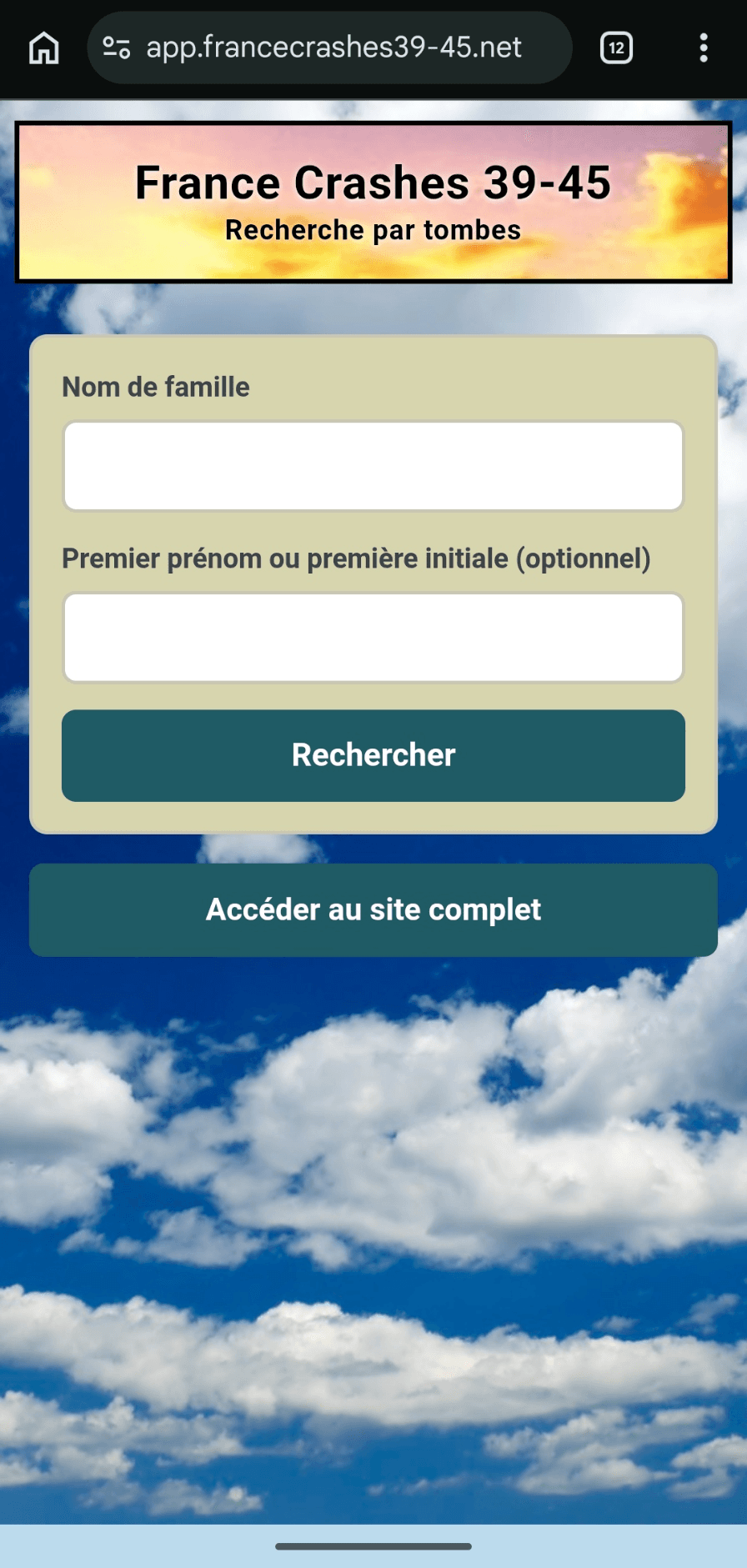
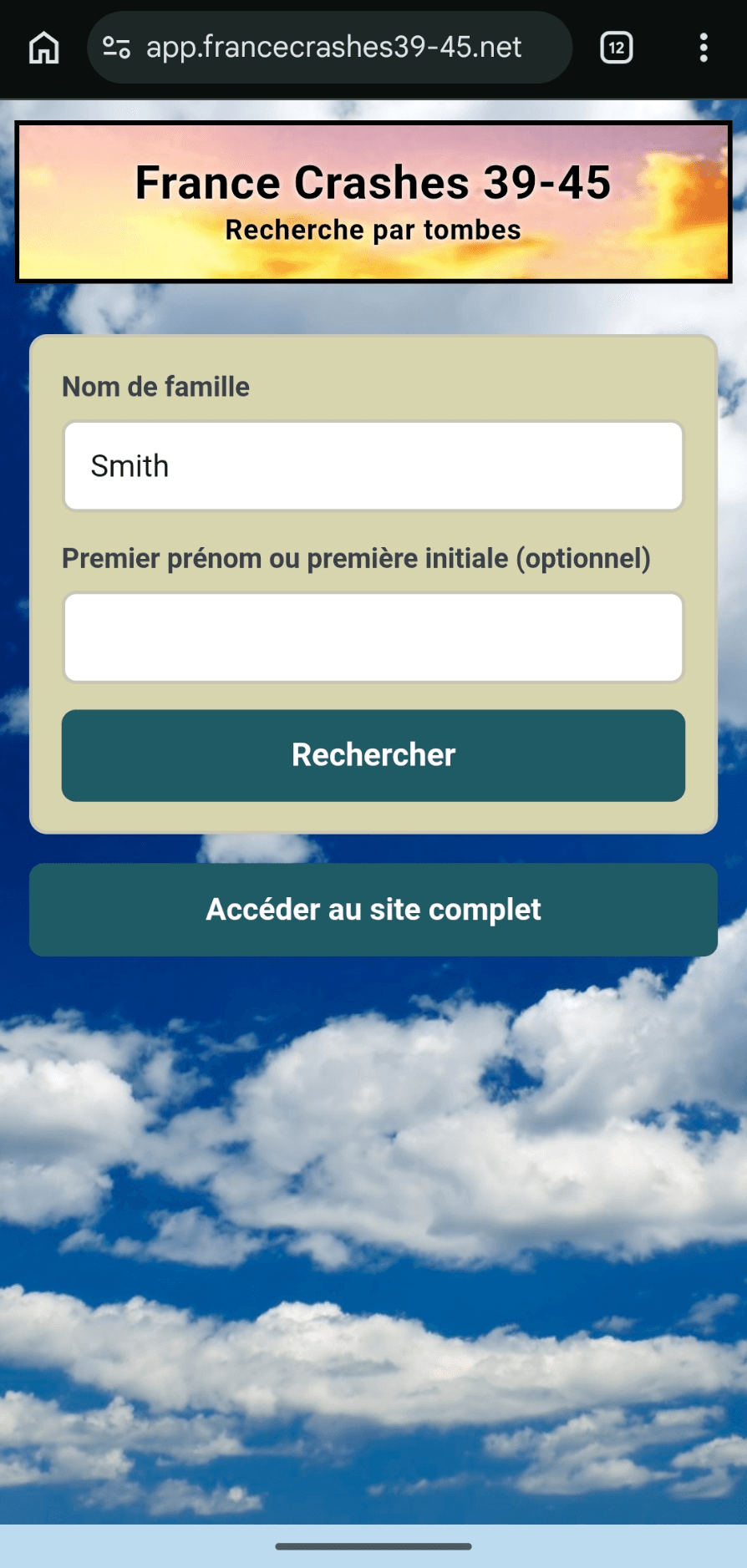
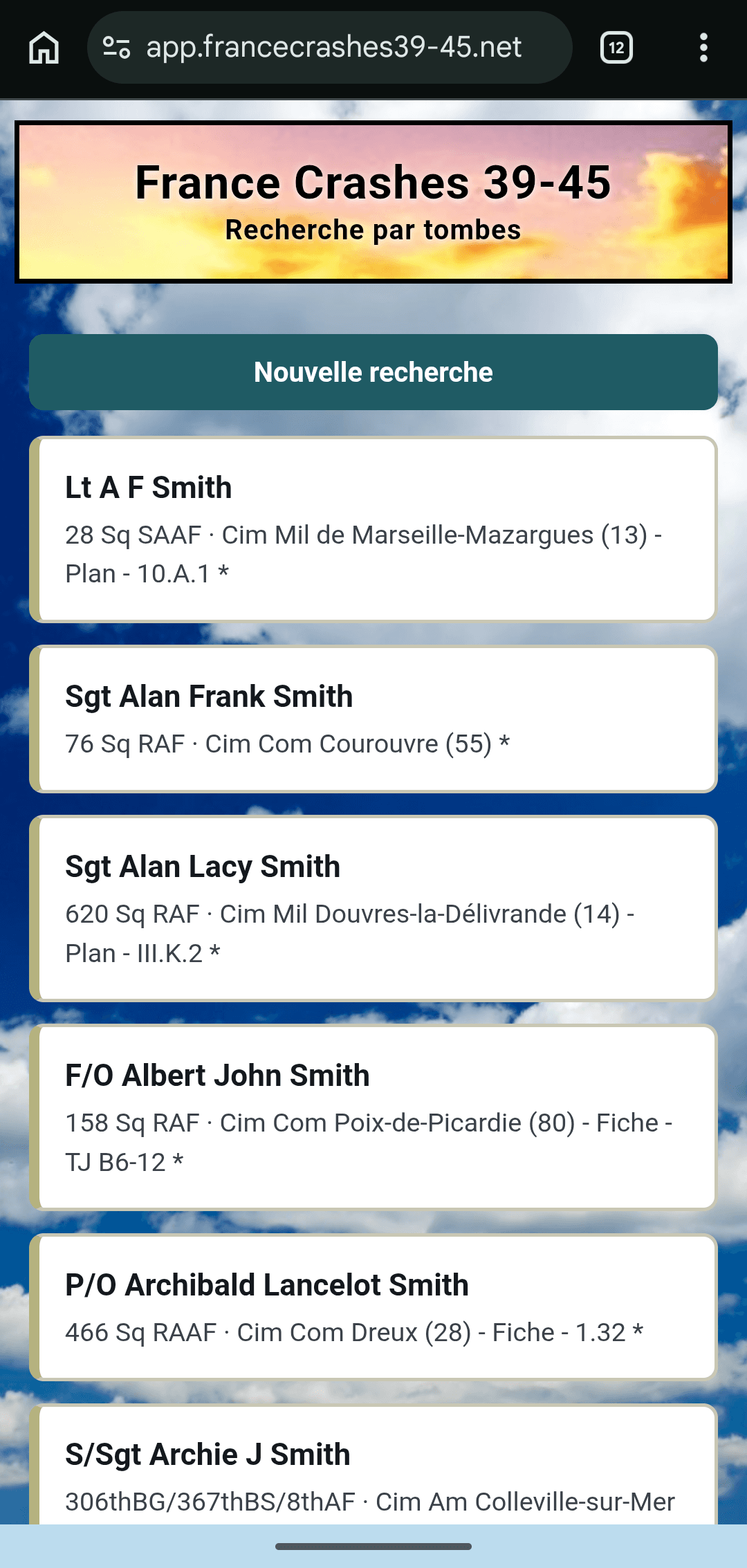
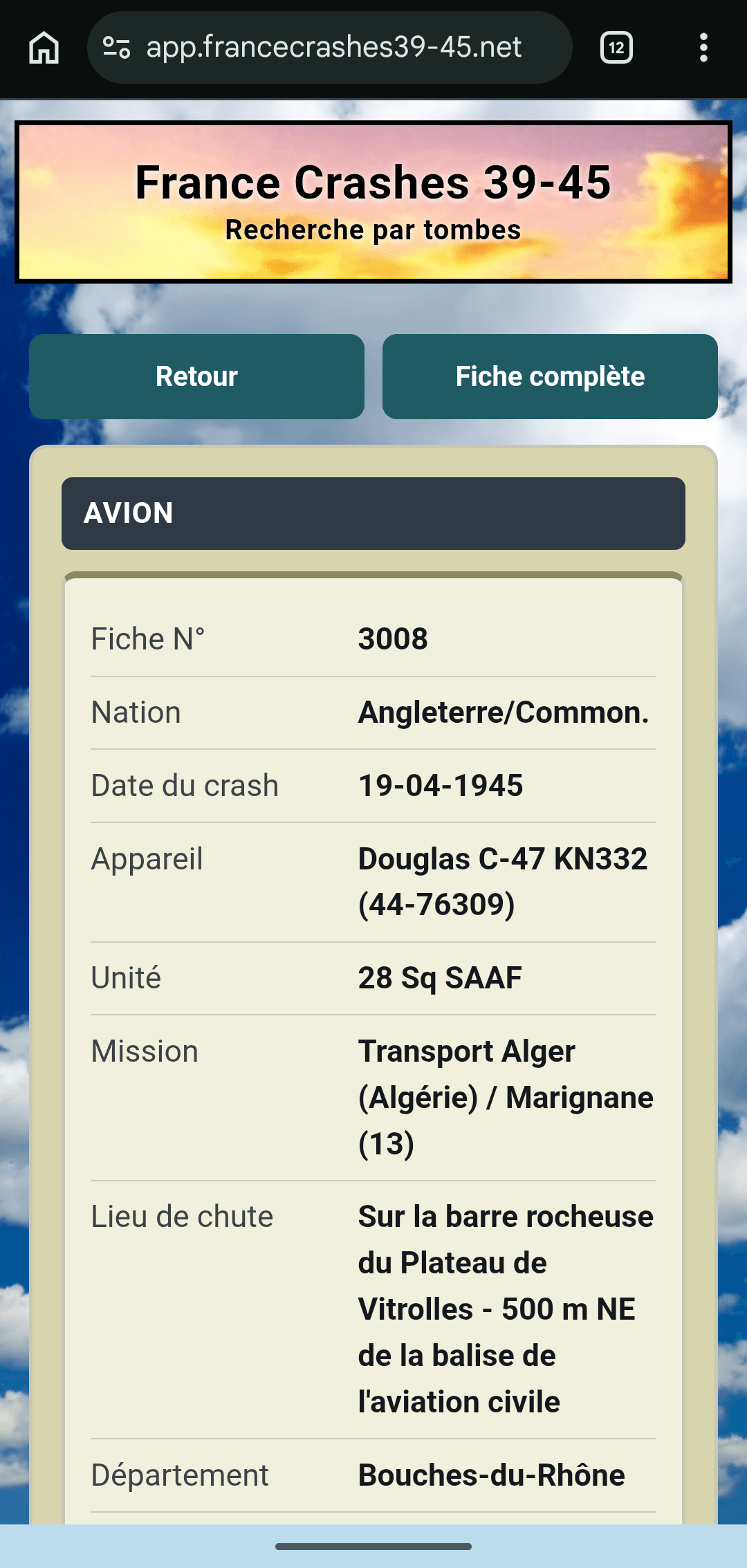
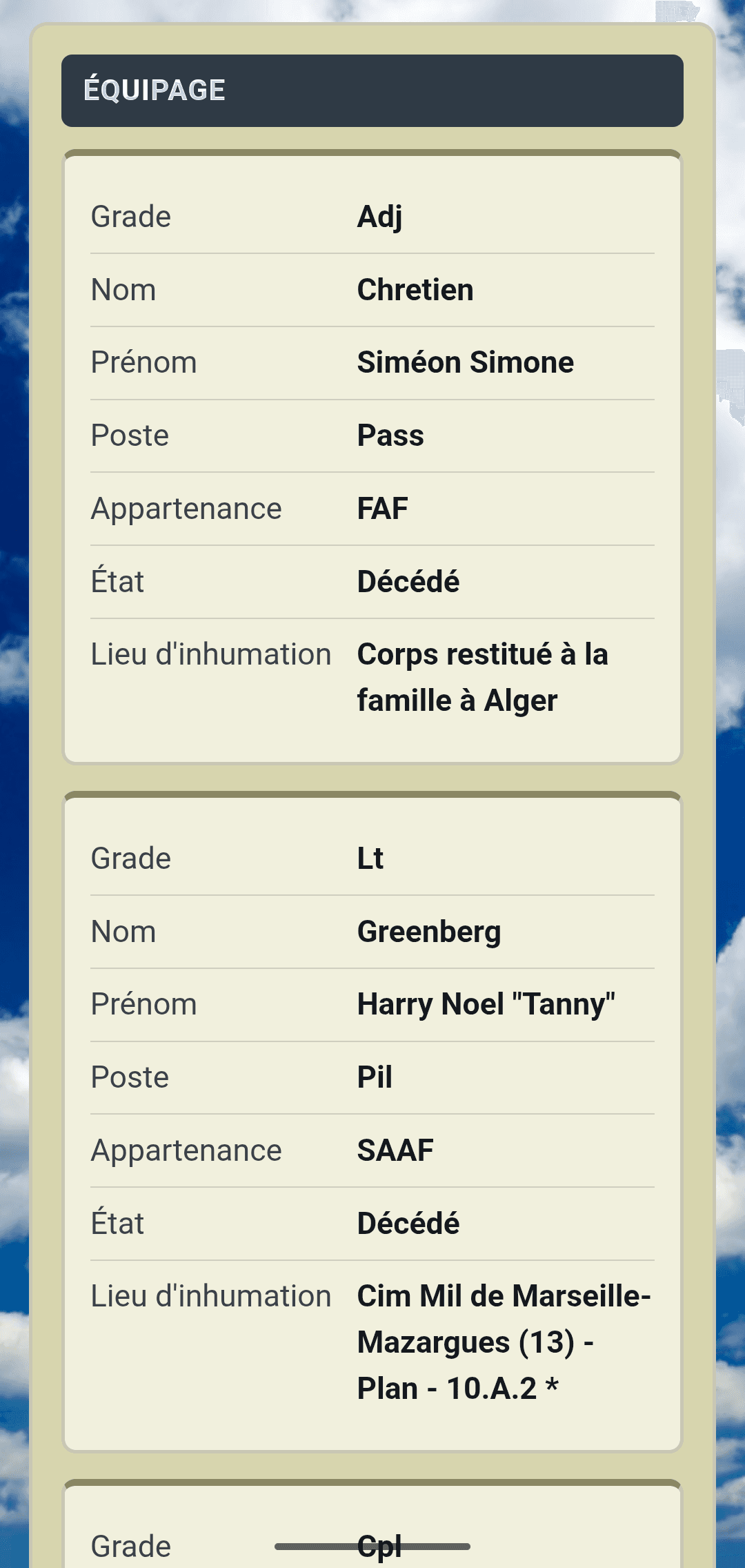
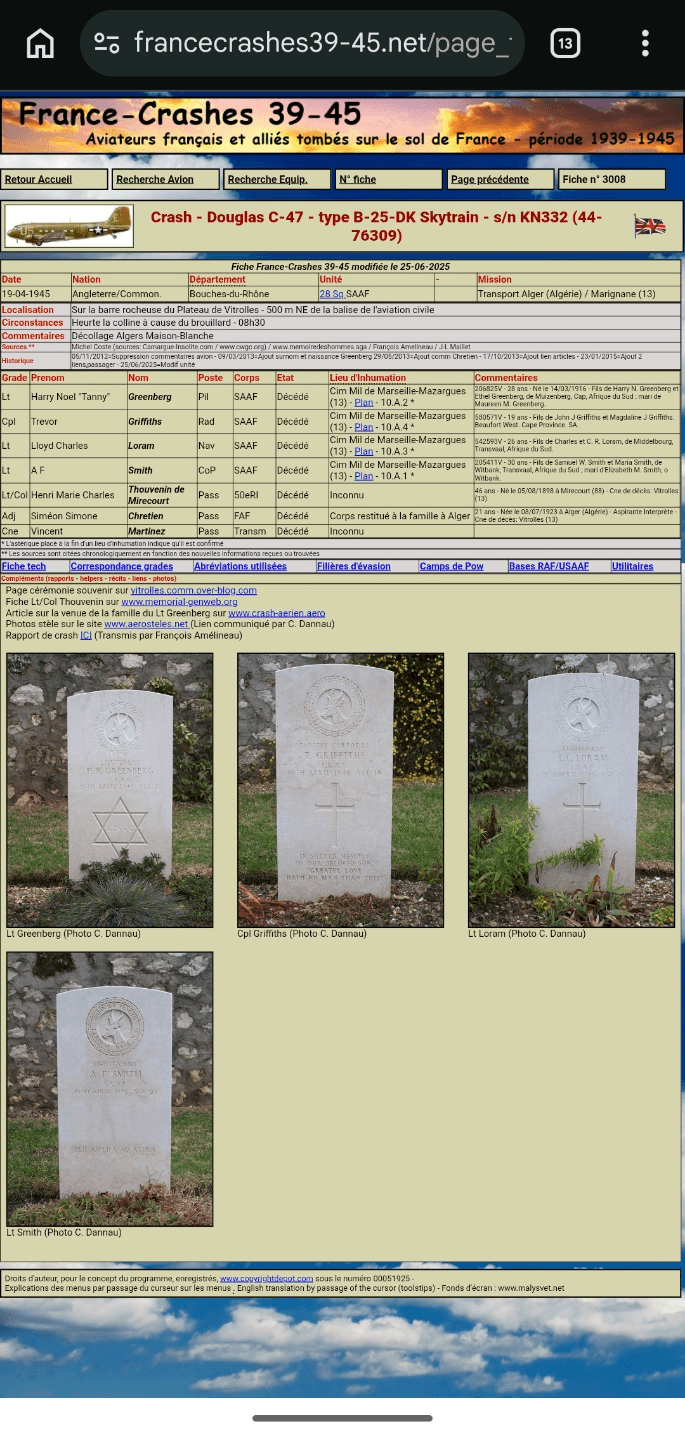
Context
The France Crashes 39-45 website records the aircraft that came down on French soil during the Second World War: aircraft records, crews, circumstances of the crashes. Online since 2008 and continuously expanded since then, it is a reference documentary database, consulted by families, historians and aviation enthusiasts.
Standing in front of an airman's grave in a cemetery, the need isn't the same as behind a computer: you have to find out within seconds, from a phone, which aircraft and which crew the name on the headstone belonged to. The mission was to deliver this mobile module, connected to the existing database, without touching the main website.
Problem & goals
Problem
- The main website has run on PHP 5.2 since 2008 and isn't responsive: on a phone, you have to zoom and scroll in every direction to read anything
- Touching the existing site meant risking breaking a website that had been online for nearly twenty years: the client wanted to take no risk, and rightly so
- Shared hosting imposed: no Composer, no external dependency, no PHP extension to install, upload by FTP
- The database has no unique airman identifier, and its text fields contain HTML inherited from the website (links, tooltips, images) that can't be displayed as is
Goals
- Make it possible to find an airman from just the name read on a grave, with the first name or a single initial
- Apply the client's business rule: never an airman record on its own, always the aircraft and the full crew
- Expose a secure API (access key, rate limiting, prepared statements) feeding the mobile module
- Stay visually consistent with the 2008 website, for an often older audience that already knows its way around, rather than imposing an unfamiliar modern interface
- Make everything configurable without touching the code, to switch from the test database to the production database
- Redirect mobile visitors from the main website to the module, in a fully reversible way
Approach
The specifications called for a standalone module: I treated it as a building block grafted onto the existing database, removable at any time.
- analysis of the actual database before writing any code: the documented structure and the delivered structure differed, and each adaptation was submitted to the client, then approved;
- a deliberate interface choice, agreed with the client: reuse the original website's visual codes (banner, sky background, palette) instead of a modern look, with large labels, strong contrasts and a single action per screen;
- design of a PHP 8.2 API with no external dependency at all, to stay compatible with the client's hosting and FTP deployment;
- building a technical airman identifier, since the database provides none, from the aircraft record and the position in the crew;
- systematic cleanup of the text fields inherited from the website: images and tooltips removed, visible text kept;
- mobile interface in plain JavaScript, with three views (search, results, record), no framework and no build step;
- a standalone device detection script, added in a single line to the main website, without touching the existing HTML or CSS.
Every deviation from the initial specifications was decided with the client, then documented in the delivered repository.
Technical highlights
API: PHP 8.2 with PDO, no Composer or third-party library. Two routes: airman search (last name with “starts with” matching, first name or initial) and aircraft record with the full crew. Internal statuses are translated into readable values (Récupéré, Échappé, Évadé, Prisonnier, Décédé, Inconnu: recovered, escaped, evaded, prisoner, deceased, unknown) and dates normalized to the DD-MM-YYYY format.
Security: Mandatory access key checked in constant time, rate limiting per key and per IP address, prepared statements, strict Unicode validation of parameters, CORS restricted to an allowlist of origins, HTTPS redirect, internal errors hidden and strict JSON responses (only the intended fields).
Database: Read-only MariaDB / MySQL on the historical database. Aircraft and crew are linked through the aircraft record; the search only returns airmen whose burial place is known, in line with the intended use.
Mobile interface: Plain HTML, CSS and JavaScript, three chained views. A deliberately understated design close to the original website: large type, strong contrasts, generous touch targets, no animation and no interaction to guess. Navigation through history.pushState: the browser's “back” button returns to the previous screen instead of leaving the application. Systematic escaping of displayed data.
Configuration: Everything is centralized in a file outside the web root: connection, access keys, allowed origins, rate limiting, link to the full record. Switching from the test database to the production database requires no code change and no redeployment.
Deployment: The module is isolated on its own subdomain, set to PHP 8.2, while the original website stays on PHP 5.2: the two versions coexist on the same hosting without getting in each other's way, and the old website didn't have to be migrated. php:8.2-apache Docker image for development and demos, upload by FTP, with URL rewriting, HTTPS and protection of the configuration folder.
Results
The live module offers:
- a search by last name, with first name or a single initial, that returns the matching airmen with their unit and burial place;
- a record combining the aircraft (nation, crash date, type, serial number, unit, mission, crash site, circumstances) and the entire crew with rank, position, status and burial place;
- a direct link to the detailed record on the main website, to read further;
- automatic redirection of smartphones and tablets from the main website, with a way out to stay on the full website;
- a test suite covering status mappings, the cleanup of inherited fields and identifier encoding, complemented by acceptance testing on the real database.
The module runs on its own subdomain without a single line of the main website having been changed: removing one script tag would be enough to undo everything.
What I learned
- working on an existing database I hadn't designed, and adapting to its actual structure rather than its documentation;
- delivering a secure API with no external dependency at all, a constraint imposed by the client's shared hosting;
- implementing portable rate limiting based on locked files, where the usual solutions assume Redis or a dedicated extension;
- designing a reversible integration that leaves the client's website intact and costs nothing to remove;
- putting the real need ahead of my developer reflexes: here, the right interface was the one visitors recognize, not the most modern one;
- settling data structure questions with a non-technical client, and documenting every approved deviation.
This project confirmed two things: a strong technical constraint doesn't prevent you from delivering something clean and secure, and a website that has been running since 2008 is better modernized by adding to it than by rewriting it.